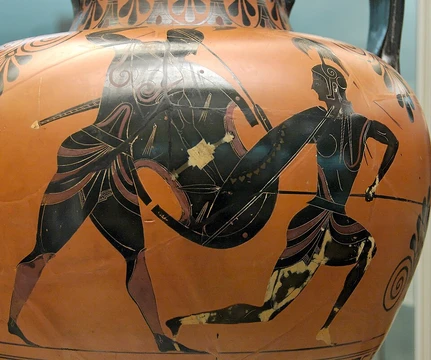
Apollo
Olympian god of light, prophecy, music, and healing.

Apollo is one of the Olympian deities in ancient Greek religion and mythology. His numerous functions include light, healing, prophecy, music, poetry, and archery. He is the son of Leto and Zeus, and the twin brother of Artemis, goddess of the hunt. He is considered to be the most beautiful god and is represented as the ideal of the kouros (ephebe, or a beardless, athletic youth). As the patron deity of Delphi (Apollo Pythios), Apollo is an oracular god—the prophetic deity of the Delphic Oracle and the deity of ritual purification. His oracles were often consulted for guidance in various matters. He was in general seen as the god who affords help and wards off evil, and is referred to as Alexicacus, the 'averter of evil'.
- born
- Mount Cynthus on the island of Delos
- field
- Greek religion and mythology
- nationality
- Greek
- known_for
- God of light, healing, prophecy, music, poetry, archery; patron of Delphi; inventor of string-music; protector of the young; pastoral deity
Lore & Background
Apollo is the son of Leto and Zeus, and twin brother of Artemis. His birthplace was Mount Cynthus on the island of Delos. He is depicted as a beardless, athletic youth with long, uncut hair symbolizing eternal youth. As the god of mousike, he presides over all music, songs, dance, and poetry, and is the inventor of string-music. The lyre is a common attribute of Apollo. He is also the patron deity of Delphi, where he served as the prophetic god of the Delphic Oracle and the deity of ritual purification. His oracles were often consulted before setting laws in a city. Medicine and healing are associated with Apollo, either through himself or through his son Asclepius. He could deliver people from epidemics but also bring ill health and deadly plague with his arrows. The invention of archery is credited to Apollo and Artemis. He is usually described as carrying a silver or golden bow and a quiver of arrows. As a pastoral deity, he was the patron of herdsmen and shepherds, protecting herds, flocks, and crops from diseases, pests, and predators. He also encouraged the founding of new towns and the establishment of civil constitutions, and was the giver of laws. Apollo Agyieus was the protector of streets, public places, and home entrances. From the 5th century BCE, Apollo was often identified with Helios, the personification of the Sun, though Latin poets did not conflate them until the 1st century CE. In Etruscan mythology, he is known as Apulu.
Reader's Guide
Apollo's significance in ancient Greek religion and mythology is vast, encompassing multiple domains that shaped both public and private life. As the god of prophecy, his Delphic Oracle was a central institution for guidance on laws, colonization, and personal matters. His role as a healer and plague-bringer reflects the dual nature of divine power over health and disease. As the patron of music, poetry, and dance, he embodied the ideal of cultural refinement and artistic inspiration, often leading the Muses. His protection of the young and oversight of their transition to adulthood made him a key figure in rites of passage. The pastoral aspects of his cult connected him to rural life and the protection of livestock and crops. His identification with the Sun (Helios) from the 5th century BCE onward reinforced his association with light and clarity. The spread of his worship to Rome by the 5th century BCE ensured his lasting influence in the Roman world. The etymology of his name remains uncertain, with ancient Greeks often linking it to 'destroy' or 'purification', while modern scholars suggest a Pre-Greek origin. His epithets, such as Phoebus ('bright'), Pythius, and Smintheus, reflect his diverse functions and local cults. Apollo's legacy endures as a symbol of harmony, reason, and artistic excellence.
Did You Know?
- Apollo is the twin brother of Artemis, goddess of the hunt.
- He is credited with the invention of archery, along with his sister Artemis.
- His chief epithet was Phoebus, meaning 'bright'.
- Apollo was often identified with Helios, the personification of the Sun, from the 5th century BCE.
Origins and the Literary Trail
The tale of Apollo and Daphne belongs to the family of Greek metamorphosis myths, yet no surviving written or artistic record from ancient Greece preserves it. Scholars therefore place its likely origin in the Hellenistic period, when such stories were first shaped into narrative form. The earliest extant source we possess is Parthenius, a Greek poet working in the first century BCE, who offered one of the first literary treatments. Ovid reframed the ancient material as a romantic vignette, casting the gods in their Roman guises while still alternating between the names Apollo and the older epithet Phoebus. That epithet traces back to Apollo's maternal grandmother, Phoibe, whose name means 'the bright one,' though scholars have never reached full consensus on why Ovid reserves the name for the sun-god aspect of the deity.
The Chase and the Laurel
The engine of the story is a petty divine quarrel. Eros, the winged god of love, is caught by Apollo stringing a man's bow, and the god of archery taunts the boy for wielding weapons meant for a warrior. Stung, Eros flies to the peak of Mount Parnassus and looses two arrows: a golden, sharp-pointed one that ignites desire, and a blunt, lead-tipped one that extinguishes it. He pins the golden shaft into Apollo, driving it to the marrow of his bones, and drives the lead shaft into Daphne. The god, now burning with an irresistible passion, spots the nymph in the forest and gives chase. Daphne, who, having modeled herself on the huntress Artemis, had devoted herself to perpetual virginity, flees at a speed the poets compare to the lightest breath of air. Eros, delighted, assists the pursuit by granting Apollo wings and clinging to Daphne's shoulders to slow her. At last, near the banks of her father's river, the exhausted nymph cries out for her parent to destroy the beauty that has drawn such a suitor. A heavy numbness seizes her limbs, and where she stood, the laurel tree takes root.
The God Behind the Pursuit
Apollo is not a one-note deity in this myth. He is simultaneously a master archer, a healer, a patron of music and the arts, a god of sunlight, a font of knowledge, and the patron of Delphi. The text presents him as the most beautiful of the gods and a formidable warrior, yet the very arrows that make him a lethal hunter become the instrument of his own vulnerability when Eros's golden tip pierces him to the bone. His identity is layered even in name: Ovid shifts between calling him Apollo and the older epithet Phoebus, a title inherited from his maternal grandmother and meaning 'the bright one,' apparently reserved for his solar aspect. In the narrative, Apollo's power is immense—he slew the Python with a thousand arrows and raised the sanctuary of Delphi upon the serpent's corpse—yet he is powerless against the wound of love, admitting that no herb can cure what a stranger's arrow has done to his heart.
The Laurel's Enduring Symbolism
The myth was traditionally invoked to explain why the laurel tree is bound to Apollo, yet the association predates the Daphne story itself. In practical religious life, the priestess at the Delphic sanctuary worked with laurel leaves, and the tree's branches became the crowning reward for victors at the Pythian Games, the festival established to commemorate Apollo's slaying of the Python. Before the laurel existed in the mythic timeline, those early champions were honored with oak wreaths—a detail that underscores how the tree's very existence is a product of Daphne's desperate transformation. Over time the laurel wreath crystallized into a broader emblem of victory and achievement, carrying the weight of both the divine contest and the personal tragedy behind its origin. The story thus operates on two levels: as aetiology for a sacred plant and as a meditation on the limits of divine power when love, rather than will, dictates the outcome.
Common Misconceptions (Editorial)
Some believe Apollo is the god of the sun only, but the facts show his functions also include healing, prophecy, music, poetry, archery, and ritual purification. Another common misconception is that Apollo and Artemis are merely hunting companions; in fact, they are twin siblings, and Apollo is credited with the invention of archery alongside her.
Why It Matters (Editorial)
Apollo endures as a symbol of the ideal balance between intellect, art, and order—embodying music, prophecy, and law as much as physical beauty. His role as the oracular god of Delphi reminds us of humanity’s enduring search for guidance, while his protection of youth and communities speaks to timeless values of care and civilization.
Frequently Asked Questions
Who is Apollo in Greek mythology?
Apollo is one of the twelve Olympian gods, born to Zeus and Leto on the island of Delos. He is the twin brother of Artemis and is traditionally depicted as a beardless, athletic young man.
What domains does Apollo govern?
His portfolio is remarkably wide, spanning light, music, poetry, healing, archery, and prophecy. He is also linked to pastoral life and the protection of young people.
What is Apollo's connection to the Delphic Oracle?
As Apollo Pythios, he is the god behind the famous Delphic Oracle, where the Pythia delivered prophecies in his name. He also presides over ritual purification, which petitioners had to undergo before consulting the shrine.
Where was Apollo born according to myth?
He was born on Mount Cynthus on the island of Delos, which is why that island became one of his most sacred cult sites throughout the ancient Greek world.
Why is Apollo considered the ideal of Greek youth?
He embodies the kouros archetype—a beardless, physically perfect young man—and represents the pinnacle of both athletic and artistic excellence in Greek culture. His composure and beauty made him the standard against which mortal youth were measured.
More in Greek Myths 1-22
Spotted an error? Know more?
This is a living reference — every entry is fact-audited, and reader corrections feed straight into our audit queue. Suggest an edit · See this site's audit record