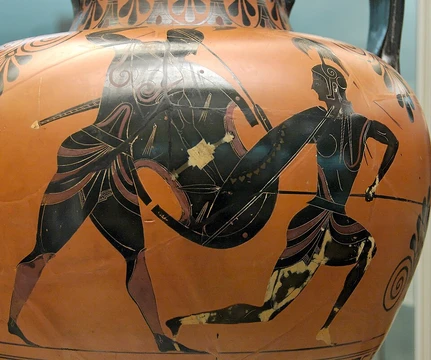
Hera
Queen of the Olympians, goddess of marriage and women.

Hera is the ancient Greek goddess of marriage, women, and family, and the protector of women during childbirth. In Greek mythology, she is queen among the twelve Olympians on Mount Olympus, sister and wife of Zeus, and daughter of the Titans Cronus and Rhea. Her defining characteristic in myth is her jealous and vengeful nature toward those who offended her, especially Zeus's adulterous lovers and illegitimate offspring.
- field
- Greek religion and mythology
- known_for
- Goddess of marriage, women, and family; queen of the Olympians; protector of women in childbirth
- sacred_animals
- Cow, cuckoo, peacock
- roman_counterpart
- Juno
- parents
- Cronus and Rhea
- consort
- Zeus
Lore & Background
Hera's name is attested in Mycenaean Greek in Linear B as e-ra, but its etymology is unclear, with several mutually exclusive proposals including 'Mistress,' 'young cow,' or a Pre-Greek origin. Ancient suggestions, such as connection to the Greek word for 'season' or Plato's link to 'beloved,' are no longer considered plausible. Many theophoric names, such as Heracles and Herodotus, derive from Hera. Hera bore several epithets in mythology and literature. She is the protector of marriage and the rights of married women, and in some cults she has functions of an earth goddess. She is occasionally related to warfare as a tutelary goddess. Her iconography presents her as a dignified, matronly figure, crowned with a polos or diadem, sometimes veiled, and she is sometimes shown holding a pomegranate as an emblem of immortality. Modern scholars suggest Hera may have been identified as an earth-goddess in some cults. In Mycenaean Greece, she was the tutelary goddess of Argos, and Homer's Iliad uses the formula 'boōpis potnia Hērē' (cow-eyed, mistress Hera), possibly relating her to a Mediterranean goddess of nature. The myth of her sacred marriage with Zeus was celebrated in many Greek festivals, and her worship was centered in the northeastern Peloponnese, especially the Argolis region, with the oldest temple at Olympia belonging to Hera.
Reader's Guide
Hera's significance in ancient Greek religion lies in her role as the goddess of lawful marriage and the protector of women during childbirth, making her a central figure in domestic and civic life. Her cult was widespread, with major centers at Argos, Samos, and Olympia, where she may have been the first deity to receive an enclosed roofed temple sanctuary around 800 BCE. The Heraion of Samos became one of the largest Greek temples. Her myths, particularly her jealous reactions to Zeus's infidelities, illustrate Greek anxieties about marriage, fidelity, and female power. The etymology of her name remains disputed, reflecting her ancient and possibly pre-Greek origins. Her Roman counterpart is Juno, and her sacred animals—the cow, cuckoo, and peacock—appear in art and literature. The epithet 'cow-eyed' and her association with the cow may link her to Near-Eastern cow-goddesses like Hathor. Her legacy endures in the many theophoric names derived from her, including Heracles and Herodotus.
Did You Know?
- Hera's name appears in Mycenaean Greek Linear B tablets from Pylos and Thebes as e-ra.
- Her sacred animals include the cow, cuckoo, and peacock.
- The oldest temple at Olympia belonged to Hera.
- Many theophoric names such as Heracles and Herodotus derive from Hera.
Sovereignty of the Hearth – Marriage, Motherhood, and Divine Jealousy
Hera occupies the highest female position among the twelve Olympian deities who dwelt on Mount Olympus. As daughter of the Titans Cronus and Rhea, she is both sister and wife of Zeus, a union that anchors her authority over lawful marriage and the rights of married women. In her capacity as patron of weddings, she presides over ceremonial unions, blessing and legalizing them, while also serving as a guardian for women navigating the dangers of childbirth. Yet this dignified maternal role coexists with a fierce, vengeful temperament. Myth consistently portrays her as deeply jealous, directing her wrath toward Zeus's numerous adulterous paramours and the illegitimate children born of those affairs. This duality—protectress of the sacred bond and punisher of its violation—defines her mythological character more than any single narrative. Her Roman counterpart, Juno, inherited this same complex of sovereign authority and protective fury, ensuring the archetype persisted across Mediterranean cultures.
The Visual Language of Hera – Iconography and Sacred Emblems
In artistic and devotional representations, Hera is consistently rendered as a stately, matronly figure—either standing upright or seated on a throne. Her head is crowned with a polos or diadem, and in some depictions she wears a veil, visually marking her as a married woman. This iconographic vocabulary reinforces her identity as the patron of lawful marriage. Among her sacred animals, the cow holds particular significance, echoing her famous epithet boōpis, "cow-eyed," which appears in Homer's Iliad and in Linear B inscriptions. The cuckoo and the peacock also feature in her symbolic retinue. In certain images she is shown holding a pomegranate, an object interpreted as an emblem of immortality. These visual markers—crown, veil, animal companions, and the pomegranate—collectively construct a recognizable theological portrait: a sovereign, married, fertile, and eternal feminine power. The consistency of these elements across Greek artistic traditions underscores how deeply embedded her iconography was in religious practice and popular devotion.
The Name Before the Goddess – Etymology and Linguistic Legacy
The name Hera, spelled Hḗrā or Hḗrē in Ionic and Homeric Greek, reaches back to Mycenaean times. Linear B tablets discovered at Pylos and Thebes record the syllabic form e-ra, and the Cypriotic dialect preserves a dative variant, e-ra-i. Despite this early attestation, no single etymology has achieved consensus. Scholars have proposed readings ranging from "Mistress" (feminine of Heros, "Master") to "young cow, heifer," the latter aligning with her boōpis epithet. A Proto-Indo-European root might have conveyed the sense of "the female who is attached or coupled," while Robert S. P. Beekes has argued for a Pre-Greek substrate origin. Ancient authors offered now-discredited links: Plato connected the name to "beloved," and Plutarch saw it as an anagram of "air." The name's lasting influence is visible in countless theophoric Greek names—Heracles, Heraclitus, Herodotus, Herodicus—each embedding the goddess's identity into the personal names of individuals across centuries.
Roots in Earth and Ritual – Fertility Cults and Sacred Marriage
Modern scholarship increasingly recognizes that Hera's identity extends beyond the Olympian sky-goddess role. In several cult contexts she functions as an earth and fertility goddess, a layer that scholars trace to her possible Mycenaean and Argive origins. Martin P. Nilsson argued she was primarily the "Argeiē," an Argive deity who guarded the citadel, and Pindar called the Argives her people. Her "sacred marriage" with Zeus was reenacted in processional festivals across the Greek world. At Samos, the Toneia festival involved hiding her image in willows for participants to find, a ritual with parallels in other fertility traditions. At Knossos in Crete, Zeus united with the earth goddess—eventually identified as Hera—in an ancient rite. The Daedala festival at Plataia dramatized a quarrel between the divine couple followed by reconciliation. In Crete, bull-worship and the Minotaur legend's hollow-cow ceremony point to a hieros gamos, a fertility-magic ritual that may predate the fully mythologized Olympian narrative.
Common Misconceptions (Editorial)
One common misconception is that Hera’s jealous and vengeful nature was her only defining trait, but the facts show she was also revered as a protector of women during childbirth and the rights of married women, even functioning as an earth goddess in some cults. Another misconception is that Hera’s name comes from the Greek word for “season” or Plato’s “beloved,” but these ancient suggestions are no longer considered plausible; her name’s etymology remains unclear and may even be Pre-Greek.
Why It Matters (Editorial)
Hera endures as a figure who embodies the contradictions of power and vulnerability in relationships—queen of the gods yet perpetually wronged, protector of marriage but unable to secure her own. Her worship, centered at one of the oldest temples at Olympia, reminds us that ancient societies wrestled with the same tensions between family loyalty, justice, and personal revenge that still resonate today.
Frequently Asked Questions
Who is Hera in Greek mythology?
Hera is the queen of the twelve Olympian gods, the wife and sister of Zeus, and the daughter of the Titans Cronus and Rhea. She presides over marriage, women, and the family unit, and she specifically shields women during childbirth.
What are Hera's powers and domain?
Her sphere of influence covers the institution of marriage, the household, and the well-being of women, particularly in labor. As the supreme female authority on Mount Olympus, she wields political power among the gods and can punish those who dishonor her marriage.
How does Hera's story end?
Hera has no death or final defeat in the surviving myths; she remains the eternal queen of Olympus. Her narrative is defined less by a single ending and more by a recurring pattern of jealousy, vengeance, and reconciliation with Zeus.
Why is Hera important to Greek mythology?
She embodies the ancient Greek ideal of the sacred marriage bond and the authority of the wife within the household. Her vengeful episodes—against Io, Heracles, Leto, and others—drive some of the most well-known stories in the entire mythological tradition.
What are Hera's sacred animals and symbols?
The cow, the cuckoo, and the peacock are all linked to her worship. The peacock's eye-patterned tail feathers are traditionally said to represent the hundred eyes of Argus, the watchman she set to guard the transformed Io.
More in Greek Myths 1-22
Spotted an error? Know more?
This is a living reference — every entry is fact-audited, and reader corrections feed straight into our audit queue. Suggest an edit · See this site's audit record