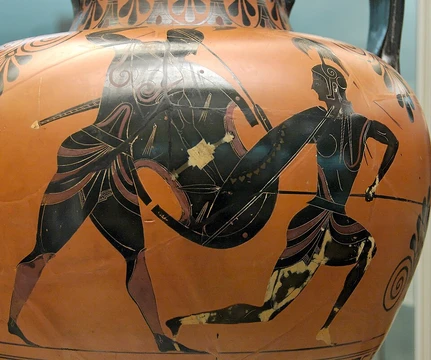
Artemis
Greek goddess of hunting, wilderness, and childbirth.

Artemis is the ancient Greek goddess of hunting, the wilderness, wild animals, transitions, nature, vegetation, childbirth, care of children, and chastity. She was widely venerated across the Greek world, and her great temple at Ephesus was one of the Seven Wonders of the Ancient World. The goddess Diana is her Roman equivalent.
- field
- Greek religion and mythology
- known_for
- Goddess of hunting, wilderness, childbirth, and chastity; twin sister of Apollo; virgin goddess; protector of children and animal cubs
Lore & Background
Artemis was the daughter of Leto and Zeus, and twin sister of Apollo. In most accounts, the twins were produced by an extramarital liaison, for which Zeus's wife Hera forbade Leto from giving birth anywhere on solid land. Only the island of Delos allowed her to give birth. In one account, Artemis is born first and then proceeds to assist Leto in the birth of Apollo. She was a kourotrophic deity, protector of children, especially girls, and animal cubs, and was worshipped and feared as one of the primary goddesses of childbirth and midwifery along with Eileithyia and Hera. She was also a patron of healing and disease, believed to send good health, illness, and death upon women and children, and a guardian over transitions from maidenhood. Artemis was one of the three major virgin goddesses, alongside Athena and Hestia, and one of the three Greek goddesses over whom Aphrodite had no power.
Reader's Guide
Artemis was one of the most widely venerated Greek deities, with her great temple at Ephesus ranking among the Seven Wonders of the Ancient World before it was burnt to the ground. Her symbols included a bow, arrow, and quiver, and the deer was sacred to her. In later times, she was identified with Selene, the personification of the Moon. The etymology of her name remains uncertain, with proposed origins including Pre-Greek, Phrygian, Persian, and Greek roots. Ancient Greek writers linked her name to words meaning 'butcher' or 'safe, pure, the stainless maiden.' Homer calls her Potnia Theron, 'the mistress of animals,' a title associated with Bronze Age art. In some cults she retains the theriomorphic form of a Pre-Greek goddess conceived as a bear, and her cults at Brauron and Piraeus featured the arkteia, where virgin girls before marriage were disguised as she-bears. Artemis is rooted to the less developed personality of the Mycenaean goddess of nature, concerned with birth and vegetation and having certain chthonic aspects. She carries functions and characteristics of a Minoan form whose history was lost in myths.
Did You Know?
- Artemis was the twin sister of Apollo and daughter of Leto and Zeus.
- The hunter Actaeon was transformed into a deer by Artemis and devoured by his own dogs after seeing her bathe.
- Artemis demanded the sacrifice of Iphigenia after King Agamemnon killed her sacred deer, but in most versions she pitied the girl and substituted a deer.
- Her great temple at Ephesus was one of the Seven Wonders of the Ancient World.
The Deception of a Sworn Maiden
Callisto, described by Hesiod as the daughter of Lycaon, king of Arcadia, lived among the mountains as a devoted follower of Artemis. Like all the nymphs in the goddess's retinue, she had pledged herself to a life of perpetual virginity, spending her days in the wilds alongside her divine patron. That sacred bond was shattered when Zeus, seeking to evade the watchful eye of his wife Hera, assumed the appearance of Artemis herself. In Ovid's rendering, the disguised god cornered Callisto while she was separated from the other nymphs, and though she sensed something was wrong the instant his kisses lost their chastity, she was physically overpowered before the real Diana could arrive. Other ancient sources, including Apollodorus and the lost comedy of the Attic playwright Amphis, preserve variants in which Zeus impersonated Apollo or in which the encounter carried explicitly lesbian undertones. Nonnus captured the shock of the situation with the terse observation that a "female paramour entered a woman's bed." The pregnancy went undetected for months until Callisto was caught bathing, and the truth became impossible to conceal.
Exile and the Ursine Curse
Once the pregnancy could no longer be hidden, Artemis's fury was immediate and absolute. In Hesiod's account, the goddess saw Callisto bathing with child and, in her rage, transformed the nymph into a beast on the spot. Ovid places the blame for the transformation on Juno, who seized the chance to avenge her wounded pride after the real Diana had already cast the pregnant girl out of her circle. Hyginus records yet another variation in which Zeus himself reshaped Callisto into a bear to conceal her from his suspicious wife, after which Hera directed Artemis to hunt the animal down. Whichever deity delivered the blow, the result was the same: a once-prized mountain nymph reduced to a wandering, snarling creature. In some tellings she was seized by Aetolian hunters or goat-herds and handed over to her own father, Lycaon, still carrying her unborn child. She gave birth to Arcas in her beastly form, and the young boy grew up in the wild. The multiplicity of these versions—Artemis as punisher, Hera as avenger, Zeus as protector—reveals how ancient audiences struggled to assign moral responsibility for a transgression that was, in the end, entirely the god's doing.
The Javelin and the Stars
The most harrowing episode in Callisto's saga comes at its close. In Ovid's telling, sixteen years after her transformation, the bear wandered into a forest where her grown son Arcas was hunting. He raised his javelin, ready to strike down the animal, entirely unaware that the creature before him was his own mother. Zeus intervened at the last instant, snatching both mother and son from the earth and fixing them in the sky as Ursa Major and Ursa Minor. Hesiod offers a slightly different sequence: the bear, not knowing the law, strayed into the forbidden precinct of Zeus and was pursued by Arcas and the Arcadians, who were about to kill her when the god stepped in and placed her among the stars, naming her the Bear in acknowledgment of the misfortune she had endured. In yet another variant preserved by Hyginus, it was Artemis who loosed the fatal arrow, shooting the bear she no longer recognized. The final celestial placement served as both punishment and salvation, lifting Callisto beyond the reach of any further violence while forever marking her with the shape of her suffering.
A Name Written in the Sky
Callisto's story did not end with her elevation to the heavens; it became embedded in the very architecture of the night sky and, millennia later, in the nomenclature of our solar system. The Greeks knew Ursa Major as Arktos, the Bear, and in some traditions the constellation was also called Helice, tied to an alternative origin narrative. Ovid supplied a poetic explanation for why the two bear constellations never dip below the horizon: Juno, furious that her revenge had been thwarted, petitioned Tethys, the primordial water goddess, to ensure that neither the Great Bear nor the Little Bear would ever touch her waters, thus accounting for their circumpolar positions as seen from ancient latitudes. Beyond the stars, Callisto's name endures on the fourth Galilean moon of Jupiter and on a main-belt asteroid, linking her myth to the physical cosmos. She was also remembered as the bear-mother of the Arcadians through her son Arcas, the eponymous ancestor of their people, a lineage that connected a violated nymph to an entire region's identity.
Common Misconceptions (Editorial)
Some assume that Artemis was primarily a nurturing maternal figure due to her association with childbirth and children, but the lore emphasizes her status as a virgin goddess and one of three major goddesses over whom Aphrodite had no power. Others mistakenly believe her temple at Ephesus was her most important mythological home; while it was a famous wonder, the lore also highlights the island of Delos as her birthplace. A common misconception is that Artemis only protected adult hunters, but the facts record that she was specifically a protector of animal cubs and children, especially girls.
Why It Matters (Editorial)
Artemis endures as a symbol of fierce independence and the untamed natural world, embodying a kind of power that exists outside patriarchal control. Her myths, from the transformation of Actaeon to the sacrifice of Iphigenia, remind us that nature and divinity are not merely gentle but also demand respect and enforce boundaries. In a modern context, she represents the tension between nurturing protection and absolute autonomy, making her a resonant figure for discussions of agency, ecology, and female power.
Frequently Asked Questions
Who is Artemis?
Artemis is a major ancient Greek goddess tied to hunting, the wild, and the protection of young children and animal cubs. She is also closely linked to chastity, nature, and the passage from girlhood into womanhood.
What are Artemis's powers and domains?
She presides over the hunt, the wilderness, wild animals, vegetation, and childbirth. She also serves as a guardian of young girls and children, and she embodies the ideal of remaining a virgin goddess.
How is Artemis related to Apollo?
Artemis and Apollo are twin siblings, both children of Zeus and Leto. Despite sharing the same parents and birth, they occupy very different spheres—she rules the wild and the hunt while he is tied to music, prophecy, and the sun.
Why was Artemis so important in ancient Greek religion?
She was worshipped across the entire Greek-speaking world, and her massive temple at Ephesus was counted among the Seven Wonders of the Ancient World. Her widespread veneration reflected how central the ideas of the hunt, protection of the young, and the natural world were to daily life.
What is Artemis's Roman equivalent?
The Romans identified her with their goddess Diana, who carried over many of the same associations with the hunt, the moon, and the protection of young people.
More in Greek Myths 1-22
Spotted an error? Know more?
This is a living reference — every entry is fact-audited, and reader corrections feed straight into our audit queue. Suggest an edit · See this site's audit record