Hades
God of the dead, riches, and king of the underworld.

Hades, in ancient Greek religion and mythology, is the god of the dead and riches and the King of the underworld, with which his name became synonymous. He was a son of Cronus and Rhea (though not the eldest child—that was Hestia), and after the Titanomachy, he received the underworld as his realm, while his brothers Zeus and Poseidon took the sky and sea.
- born
- Son of Cronus and Rhea (not the firstborn; Hestia was the eldest)
Lore & Background
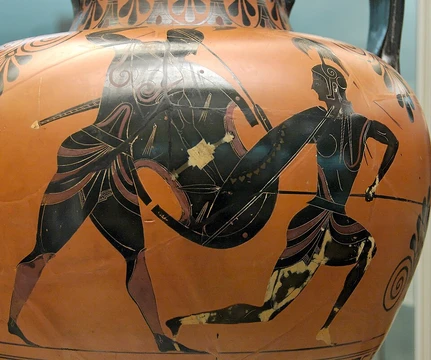
Hades was a son of the Titans Cronus and Rhea, but not the firstborn—Hestia was. He and his siblings, including Zeus and Poseidon, overthrew the Titans and divided the cosmos: Hades received the underworld, Zeus the sky, and Poseidon the sea. He obtained his wife and queen, Persephone, through abduction at the behest of Zeus, a myth central to the Eleusinian Mysteries. Hades ruled the dead with complete authority, assisted by others, and rarely left the underworld. He strictly forbade his subjects from leaving and punished those who tried to cheat death, such as Sisyphus and Pirithous. He was portrayed as passive, stern, and indifferent, but also ruthless when crossed. He was depicted outside the underworld on a few occasions: when Heracles wounded him with an arrow as Hades fought among the Pylians, when he abducted Persephone, when he sought a healer after being wounded, and when he traveled to Olympus.
Reader's Guide
Hades is significant as the personification of the underworld and the god who governed the realm of the dead in Greek mythology. His name became synonymous with the underworld itself. The myth of his abduction of Persephone explained the seasons and was central to the Eleusinian Mysteries. Roman-era mythographers equated him with Etruscan Aita and Roman Dis Pater and Orcus, merging them into Pluto, a Latinisation of Plouton, a euphemistic title meaning 'the rich one.' This title reflected the belief that from the earth come riches such as crops and metals. Hades was also referred to as Zeus katachthonios ('Zeus of the underworld') by those avoiding his name. His role in maintaining balance and his strict enforcement of his laws made him a feared but necessary figure in Greek cosmology.
Did You Know?
- The origin of Hades's name is uncertain but has generally been seen as meaning 'the unseen one' since antiquity.
- Hades was a son of Cronus and Rhea, but not the eldest child—Hestia was the firstborn, and Zeus was the last to be regurgitated by Cronus.
- He obtained his wife Persephone through abduction at the behest of Zeus.
- Roman-era mythographers equated Hades with the Etruscan god Aita and the Roman gods Dis Pater and Orcus, merging them into Pluto.
Gameplay Architecture & Combat Innovation
Hades II retains the roguelike dungeon-crawler foundation of its predecessor while expanding structural design considerably. Where the original offered a single linear descent through four biomes, the sequel splits progression into two distinct routes: an Underworld path threading through Erebus, Oceanus, the Fields of Mourning, and Tartarus, and a Surface path spanning the City of Ephyra, the Rift of Thessaly, Mount Olympus, and the Summit. Each region unlocks only after the previous one is cleared, and each is guarded by a named boss, ranging from Hecate and Scylla in the lower depths to Polyphemus, Eris, Prometheus, and Typhon above. Combat gains new layers: a lock-on cast that pins enemies in place, a Magick Bar that recharges through attacks to fuel special moves, and a Hex system tied to the goddess Selene that players enhance via a per-run skill tree. Boons from the Olympians still grant three-choice persistent buffs, and the Crossroads between runs remains the hub for upgrading weapons, crafting incantations, and deepening NPC bonds. A carried-over God Mode mechanic lets players stack up to 80 percent damage resistance across failed attempts.
Narrative & Character Arc
The story centers on Melinoë, Zagreus's newborn sister, raised in isolation by Hecate after Chronos, the Titan of Time, seizes the Underworld and imprisons Hades, Persephone, and Zagreus. Trained to avenge her family, Melinoë descends to Tartarus with Olympian boons and eventually slays Chronos, only to watch him resurrect through his mastery over time. The conflict escalates when Prometheus and Typhon launch a siege on Olympus, forcing Melinoë into a second campaign across the surface. The resolution requires a temporal split: Melinoë strikes Chronos in the present while a past-version of Zagreus, reached through Nyx's Mirror, confronts him in the past. Rather than killing him, Zagreus shows Chronos an alternate timeline in which he lives peacefully with Melinoë and her family, prompting genuine repentance. The most striking revelation arrives in the denouement: Hecate is herself a version of Melinoë from another timeline who, after successfully killing Chronos, was flung to the beginning of time and infiltrated the House of Hades to train her younger counterpart. In the epilogue, the Fates announce their intention to step back, ushering in a golden age where mortals choose their own fates.
Development & Release Timeline
Hades II marked a significant milestone for Supergiant Games: the studio's first sequel. Critically, the game was widely praised for its gameplay depth, art direction, musical score, and voice performances. However, reviewers noted that the ending, as it stood at launch, drew some criticism, suggesting the narrative conclusion may have benefited from further refinement. The project also carried the weight of being the first entry in what could become an ongoing franchise, setting expectations for how Supergiant would handle sequels, downloadable content, and future expansions in the roguelike action-RPG space.
Meta-Progression & Player Agency
A defining pillar of Hades II's design is the layered meta-progression system anchored in the Crossroads, the overworld hub between runs. When Melinoë falls, having exhausted her death defiances, she returns here to spend resources salvaged from failed attempts. Players unlock and upgrade Melinoë's abilities, craft incantations that introduce new mechanics into subsequent runs, and obtain or enhance new weapons. The social dimension is equally important: Melinoë can deepen bonds with the Crossroads' residents and, as the plot unfolds, pursue romantic relationships with non-player characters. The God Mode carryover from the first game adds a strategic layer, granting 20 percent base damage resistance that increases by 2 percent per failed run, capping at 80 percent. This creates a gradual power curve that rewards persistence without removing the core challenge of each individual run. The Hex system, tied to Selene, further personalizes play by letting players invest in summon attacks that evolve through a per-run skill tree, ensuring that no two attempts feel identical even with the same weapon loadout.
Common Misconceptions (Editorial)
Some believe Hades was the eldest child of Cronus and Rhea, but the records state Hestia was the firstborn. Others assume Hades never left the underworld, but the facts note he did on occasions including when wounded by Heracles, when abducting Persephone, when seeking a healer, and when traveling to Olympus.
Why It Matters (Editorial)
Hades endures as a figure because he embodies humanity’s oldest concern—what happens after death—while also representing the cold impartiality of fate. His myth, particularly the abduction of Persephone, continues to resonate as a story of power, loss, and the cycles of nature, reminding us that even gods are bound by the consequences of their choices.
Frequently Asked Questions
Who is Hades in Greek mythology?
Hades is the eldest son of Cronus and Rhea who, after the war against the Titans, was allotted the realm beneath the earth. He serves as the sovereign ruler over all who die and is also associated with the wealth stored underground.
What exactly does Hades rule over?
He governs the underworld, the domain of every deceased soul. His portfolio also includes subterranean riches such as metals and minerals, which is why he is sometimes called the god of wealth.
How did Hades get the underworld as his domain?
After Zeus and his siblings defeated the Titans in the great war, the three brothers divided the cosmos among themselves. Zeus took the sky, Poseidon claimed the sea, and Hades received the subterranean realm as his kingdom.
What is the story of Persephone and Hades?
Hades took Persephone, daughter of Demeter, down to the underworld, and this act became the mythological explanation for the changing seasons. Her annual return to the surface brings spring, while her absence causes winter.
Why is Hades often confused with the underworld itself?
In everyday Greek usage, the name shifted to mean the place of the dead rather than just the god who rules it. This linguistic overlap is why people sometimes say 'going to Hades' when they actually mean the afterlife realm.
More in Greek Myths 1-22
Spotted an error? Know more?
This is a living reference — every entry is fact-audited, and reader corrections feed straight into our audit queue. Suggest an edit · See this site's audit record