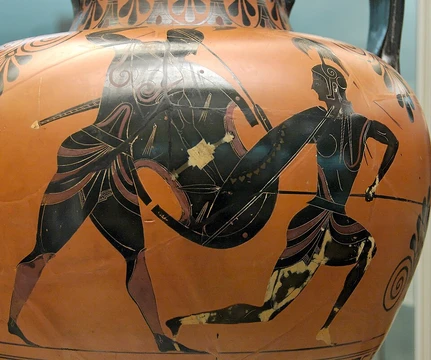
Hermes
Olympian herald, psychopomp, and divine trickster.

Hermes is an Olympian deity in ancient Greek religion and mythology, known as the herald of the gods. He is also considered the protector of human heralds, travelers, thieves, merchants, and orators. He is able to move quickly between the mortal and divine worlds, aided by his winged sandals, and serves as a psychopomp, guiding souls into the afterlife. His main symbol is the caduceus, a winged staff intertwined with two snakes.
- field
- Greek mythology and religion
- known_for
- Herald of the gods, psychopomp, divine trickster, protector of travelers and merchants
- symbols
- Caduceus, winged sandals, petasos, herma, rooster, tortoise
Lore & Background
Hermes is presented in myth as the son of Zeus and Maia, the Pleiad. He functions as the emissary and messenger of the gods and is regarded as the divine trickster, a role most famously described in the Homeric Hymn to Hermes. His attributes include the herma, rooster, tortoise, satchel, winged sandals (talaria), and winged helmet or petasos, as well as the caduceus. The earliest form of his name is Mycenaean Greek *hermāhās, written in Linear B. Most scholars derive Hermes from Greek ἕρμα (herma), meaning 'stone heap,' though the etymology is uncertain and may be Pre-Greek. It is likely he is a pre-Hellenic god, with some scholars suggesting origins as a Mesopotamian snake-god or based on the Thoth archetype. His cult was established in remote regions of Greece, possibly originally as a god of nature, farmers, and shepherds, with shamanic attributes linked to divination and mediation between worlds.
Reader's Guide
Hermes's significance lies in his multifaceted role as a mediator between the mortal and divine, the living and the dead. As a psychopomp, he guides souls to the afterlife, and as a god of boundaries, his image was placed on gravestones and boundary markers. His functions expanded from chthonic and underworld associations to encompass roads, travelers, commerce, and even literary creation and rhetoric. After the Renaissance, the caduceus became a symbol of commerce. Hermes's legacy persists in Western culture through his iconography and the enduring recognition of his roles as herald, trickster, and guide.
Did You Know?
- Hermes is able to move quickly between mortal and divine worlds aided by his winged sandals.
- His main symbol is the caduceus, a winged staff intertwined with two snakes copulating.
- The earliest form of his name is Mycenaean Greek *hermāhās, written in Linear B script.
- In Roman mythology, many of Hermes's characteristics belong to Mercury, whose name derives from Latin merx, meaning 'merchandise.'
Roles and Domains in the Greek Pantheon
Hermes occupies a remarkably broad portfolio among the Olympian deities, functioning simultaneously as the herald who carries messages between the gods and as a protector extended to several categories of human activity. Travelers, merchants, orators, and even thieves all fall under his patronage, a range that speaks to his role as a boundary-crosser rather than a specialist in any single domain. His ability to slip freely between the mortal and divine realms—aided by his winged sandals—makes him the natural intermediary in a cosmos where gods and humans occupy separate spheres. Beyond his messenger duties, Hermes serves as psychopomp, the guide who conducts the souls of the dead into the afterlife, a role that underscores his liminal nature. In mythological narrative, he is the son of Zeus and Maia, one of the Pleiads, and the Homeric Hymn to Hermes presents him as the divine trickster, a characterization that adds a mischievous, subversive layer to his otherwise dutiful service. This combination of official function and playful cunning makes him one of the most versatile figures in the Greek pantheon.
Name, Etymology, and Pre-Hellenic Origins
The name Hermes carries deep linguistic roots that scholars continue to debate. The earliest attested form appears in Mycenaean Linear B as e-ma-a2, reconstructed as *hermāhās, with later variants such as Hermeias, Hermaōn, and Hermaiuos. Most etymologists trace the name to the Greek word herma, meaning a stone heap, and sacred sites like the Hermaion and hermaios hills were dedicated to him. However, the ultimate origin of herma itself remains uncertain; it is probably not a Proto-Indo-European inheritance, and some scholars, including Beekes, argue for a Pre-Greek substrate. The god himself is widely regarded as pre-Hellenic, with his earliest cults established in remote, rural regions where he likely served as a deity of nature, farmers, and shepherds. A well-supported theory links him to Pan, identified as a reflex of the Proto-Indo-European pastoral god *Péh2usōn, whose root *peh2 ('protect') also yields the Latin word pastor. In this model, Hermes absorbed Pan's earlier functions as psychopomp and guardian of boundaries, while Pan retreated to his more rustic Arcadian identity. Later myth even recast Pan as Hermes's son, a narrative that mirrors the historical absorption of one cult into another.
Iconography and the Evolution of His Image
The visual identity of Hermes shifted considerably across Greek artistic periods, yet certain objects remained constant markers of his presence. In Archaic sculpture, he typically appeared as a mature, bearded man dressed as a traveler, herald, or shepherd—an image that persisted on the stone Hermai serving as boundary and grave markers. By the Classical and Hellenistic periods, artists favored a younger, athletic, beardless figure; Homer described him as a youth with the faintest down on his upper lip, while the satirist Lucian placed that down on his cheeks. When portrayed as Logios, the speaker, his bearing reflected that oratorical function, and Praxiteles depicted him cradling the infant Dionysus. Regardless of era, his identification relied on a consistent set of attributes: the wide-brimmed petasos, later adorned with small wings; the talaria, or winged sandals; and the caduceus, a staff around which two snakes are coiled, sometimes crowned with wings and a sphere. The caduceus was said to lull listeners to sleep or rouse them, to broker peace between disputing parties, and to serve as a sceptre of his authority. It must be distinguished from the Rod of Asclepius, which bears a single snake and belongs to the medical god.
Cross-Cultural Legacy and the Roman Transformation
Hermes's influence extends far beyond the Greek-speaking world, and his attributes were absorbed into deities across the ancient Mediterranean and Near East. In Roman religion, the bulk of his characteristics transferred to Mercury, a name drawn from the Latin merx, meaning merchandise, the root from which the English words merchant and commerce descend. This etymology underscores how central commerce was to the god's Roman identity. The connection to Egypt is equally significant: Herodotus was the first ancient writer to equate Hermes with the Egyptian deity Thoth, an identification later echoed by Plutarch and Diodorus, though Plato argued the two gods were fundamentally different. The merging of Hermes's traits with the Thoth archetype developed after Homer's time among Greeks and Romans. Parallels also reach into Mesopotamia, where the god Ningishzida, a mediator between humanity and the divine—particularly the goddess Ishtar—was depicted with a symbol strikingly similar to the caduceus, a staff bearing two coiled snakes. These cross-cultural resonances suggest that Hermes, or the archetypes he embodies, tap into a shared ancient vocabulary of mediation, boundary-crossing, and exchange between worlds.
Common Misconceptions (Editorial)
Some people assume the caduceus is exclusively a symbol of medicine, but in Greek mythology it is primarily the symbol of Hermes, representing his roles as herald, messenger, and guide of souls. Another common error is the belief that Hermes was only a minor messenger god; in fact, he was an Olympian deity, a divine trickster, and the protector of travelers, thieves, merchants, and orators.
Why It Matters (Editorial)
Hermes endures because he embodies the essential human experiences of movement, communication, and transition. As the messenger between worlds and the guide of souls, he represents the constant crossing of boundaries — between life and death, mortal and divine, order and mischief — a figure who reminds us that even the gods need a trickster to keep the cosmos dynamic.
Frequently Asked Questions
Who is Hermes?
Hermes is one of the twelve Olympian gods, best known as the divine messenger who shuttles news between the gods and the mortal world. He also serves as a psychopomp, escorting the souls of the dead into the afterlife.
What are Hermes's powers and roles?
He is famed for his lightning speed, bolstered by his winged sandals, and for his role as a divine trickster who routinely outwits other gods. In the mortal sphere he watches over travelers, merchants, thieves, and orators.
What are Hermes's main symbols?
His most recognizable emblem is the caduceus, a winged staff wrapped by two serpents. He is also linked to the petasos hat, winged sandals, the herma pillar, a rooster, and a tortoise.
How does Hermes's story end?
As an eternal Olympian, Hermes has no narrative death or final fate the way mortal heroes do. His myths simply show him continuing his duties as herald, trickster, and soul-guide across the whole cycle of Greek stories.
Why is Hermes important in Greek mythology?
He acts as the essential bridge between the divine and human realms, carrying messages and guiding souls across that boundary. His versatility as messenger, trickster, and protector makes him one of the most frequently invoked figures throughout the myths.
More in Greek Myths 1-22
Spotted an error? Know more?
This is a living reference — every entry is fact-audited, and reader corrections feed straight into our audit queue. Suggest an edit · See this site's audit record