Medusa
Gorgon whose gaze turned onlookers to stone.

Medusa, also called Gorgo or the Gorgon, was one of the three Gorgons in Greek mythology. She is generally described as a woman with living snakes in place of hair, and her appearance was so hideous that anyone who looked upon her was turned to stone. Medusa and her Gorgon sisters Euryale and Stheno were usually described as daughters of Phorcys and Ceto; of the three, only Medusa was mortal.
- also known as
- Gorgo, the Gorgon
- parents
- Phorcys and Ceto (according to Hesiod and Apollodorus); Hyginus gives parents as 'Gorgon' and Ceto
- siblings
- Euryale, Stheno, and the Graeae
- mortality
- Mortal (only one of the three Gorgons)
- slain by
- Perseus
- offspring
- Pegasus and Chrysaor (born after her death)
- associated locations
- Sarpedon near Cisthene (Hesiod, Aeschylus); Libya (Dionysius Scytobrachion, Herodotus)
Lore & Background
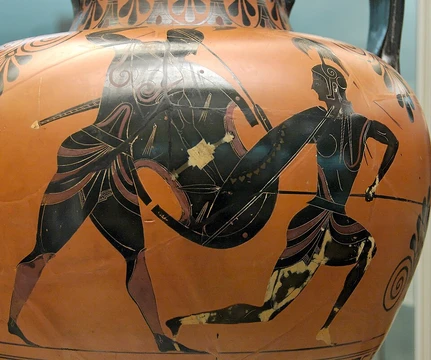
In a late version by the Roman poet Ovid, Medusa was originally a beautiful maiden, but after Neptune mated with her in the temple of Minerva, the goddess punished her by transforming her hair into snakes. Ancient Greek vase-painters and relief carvers imagined Medusa as monstrous, but by the fifth century BC sculptors and vase-painters began to depict her as beautiful as well as terrifying.
Reader's Guide
Medusa's significance extends beyond her role in myth. In classical antiquity, her head appeared in the apotropaic device known as the Gorgoneion, used to ward off evil. Modern interpretations have varied widely: some early scholars saw the myth as a quasi-historical memory of an invasion; psychoanalyst Sigmund Freud interpreted Medusa's head as a symbol of castration terror. In the 20th century, feminists reassessed Medusa as a symbol of female rage, with her visage adopted by many women as an emblem of that emotion. The name 'Medusa' itself often connotes malevolence, though her origins in myth include claims of beauty. The myth has been used in modern culture, including as a logo by fashion company Versace. The tripling of Medusa into three sisters is considered by scholar Jane Ellen Harrison to be a secondary feature, with the real Gorgon being Medusa alone.
Did You Know?
- Medusa was the only mortal among the three Gorgons.
- Perseus beheaded Medusa while looking at her reflection in a mirrored shield from Athena.
- From Medusa's blood sprang Pegasus, Chrysaor, the Amphisbaena, and the venomous vipers of the Sahara.
- In a late version by Ovid, Medusa was originally a beautiful maiden punished by Minerva.
Common Misconceptions (Editorial)
A common misconception is that all Gorgons were immortal. In fact, only Medusa was mortal, while her sisters Euryale and Stheno were not. Another misconception is that Medusa was always depicted with a monstrous face; by the fifth century BC, Greek sculptors and vase-painters began to portray her as both beautiful and terrifying.
Why It Matters (Editorial)
Medusa endures as a complex symbol of both victimhood and power, shifting from a monstrous figure in early Greek art to a tragic one in later Roman poetry. Her story reflects ancient anxieties about divine punishment and female agency, while her iconic gaze continues to resonate in modern discussions of how society turns trauma into myth.
Spotted an error? Know more?
This is a living reference — every entry is fact-audited, and reader corrections feed straight into our audit queue. Suggest an edit · See this site's audit record