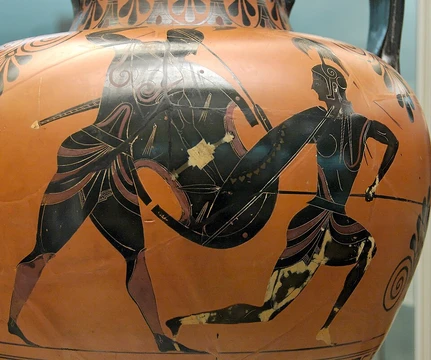
Odysseus
Legendary Greek king of Ithaca and hero of Homer's Odyssey.

Odysseus, also known by the Latin variant Ulysses, is a legendary Greek king of Ithaca and the hero of Homer's epic poem, the Odyssey. He also plays a key role in Homer's Iliad and other works in the epic cycle. Renowned for his intellectual brilliance, guile, and versatility (polytropos), he is known by the epithet Odysseus the Cunning.
- known_for
- Hero of Homer's Odyssey; key role in the Iliad; renowned for cunning intelligence (mêtis); his ten-year homecoming (nostos) after the Trojan War
- field
- Greek and Roman mythology
- nationality
- Greek (king of Ithaca)
- family
- Son of Laërtes and Anticlea; husband of Penelope; father of Telemachus, Acusilaus, and Telegonus
Lore & Background
Odysseus is the son of Laërtes and Anticlea, husband of Penelope, and father of Telemachus, Acusilaus, and Telegonus. His name has an unknown etymology, though Homer relates it to the verb odussomai ('to be wroth against, to hate'). In the Odyssey, his grandfather Autolycus names him Odysseus because 'I have been angered with many.' He is also known by the patronymic epithet Laertiades ('son of Laërtes'). In Latin, he was known as Ulixēs or Ulyssēs; some scholars suggest there may originally have been two separate figures later combined.
Reader's Guide
Odysseus is most famous for his nostos, or 'homecoming', which took ten eventful years after the decade-long Trojan War. In the Iliad, he is one of the most influential Greek champions, a trusted counsellor and advisor who restores order and champions the Achaean cause. His intellectual brilliance and versatility are encapsulated in the Greek word polytropos ('man of many turns'). The etymology of his name remains unknown, with some scholars proposing a Pre-Greek origin. His legacy endures as the archetypal cunning hero, whose journey home has become a foundational narrative of Western literature.
Did You Know?
- Odysseus is also known by the Latin variant Ulysses.
- His name may have a non-Greek, possibly Pre-Greek origin.
- In vase inscriptions, variants include Oliseus, Olyseus, and Olyteus.
- He is described in the Iliad as shorter than Agamemnon but broader in the chest and shoulders.
Common Misconceptions (Editorial)
A common misconception is that Odysseus was only a hero in the *Odyssey*, but he also plays a key role in Homer’s *Iliad* and other works in the epic cycle. Another is that his name has a clear Greek meaning; while Homer connects it to the verb *odussomai* (“to hate”), its etymology is actually unknown and may be of Pre-Greek origin. Some people assume he was the tallest or most physically imposing of the Greek heroes, but the facts note that in the *Iliad* he is described as shorter than Agamemnon, though broader in the chest and shoulders.
Why It Matters (Editorial)
Odysseus endures because he represents the archetypal human struggle for home and identity, blending physical endurance with intellectual cunning in a way that feels modern. His ten-year journey, the *nostos*, is not just a tale of adventure but a profound meditation on perseverance, loyalty, and the cost of war—themes that remain timeless.
Spotted an error? Know more?
This is a living reference — every entry is fact-audited, and reader corrections feed straight into our audit queue. Suggest an edit · See this site's audit record