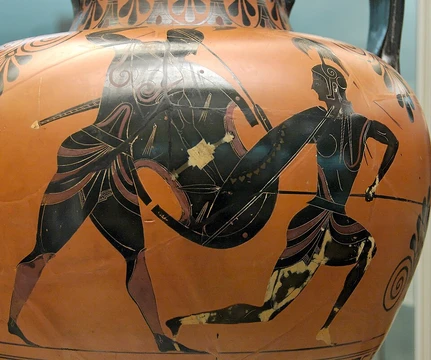
Prometheus
Titan who stole fire and gave civilization to humanity.

Prometheus is a Titan in Greek mythology, credited with creating or aiding humanity in its earliest days. He defied the Olympian gods by stealing fire and giving it to humanity in the form of technology, knowledge, and civilization, and is often seen as a champion of mankind and the author of the human arts and sciences.
- mythological_origin
- Greek mythology
- species
- Titan
- known_for
- Stealing fire from the gods and giving it to humanity; creator of humanity from clay (in some versions); establishing animal sacrifice; father of Deucalion (in some versions)
- associated_deities
- Athena, Hephaestus
- punishment
- Bound to a rock; an eagle ate his liver daily, which regenerated each night; eventually freed by Heracles
- etymology
- Possibly meaning 'forethought'
Lore & Background
Prometheus was a son of the Titan Iapetus by Clymene or Asia, and brother to Menoetius, Atlas, and Epimetheus. In Hesiod's Theogony, he tricked Zeus at a sacrificial meal by offering two choices: beef hidden inside an ox's stomach, and bones wrapped in fat. Zeus chose the bones, setting a precedent for future sacrifices. Angered, Zeus hid fire from humans, but Prometheus stole it back in a fennel stalk. Zeus retaliated by sending Pandora, the first woman, to humanity, and condemned Prometheus to eternal torment: bound to a rock, an eagle ate his liver each day, which grew back each night. He was eventually freed by the hero Heracles.
Reader's Guide
Prometheus became a central figure in Western classical tradition, representing human striving, particularly the quest for scientific knowledge, and the risk of overreaching or unintended consequences. In the Romantic era, he was seen as the lone genius whose efforts to improve human existence could also result in tragedy. The etymology of his name is uncertain but may mean 'forethought.' His story appears in Hesiod's Theogony and Works and Days, and some scholars suggest parallels with the Sumerian myth of Enki.
Did You Know?
- Prometheus's liver was eaten daily by an eagle and regenerated each night, as the liver was thought to be the seat of human emotions.
- In some versions of the myth, Prometheus created humanity from clay.
- The struggle of Prometheus is located by some at Mount Elbrus or Mount Kazbek in the Caucasus Mountains.
- The etymology of 'Prometheus' is debated but may mean 'forethought.'
Common Misconceptions (Editorial)
A common misconception is that Prometheus was a god; in fact, he was a Titan. Some also believe he was solely punished by being chained to a rock, but the myths specify that an eagle ate his liver each day, which regenerated each night, and that he was eventually freed by Heracles. Additionally, while many know him for stealing fire, the facts record that in some versions he also created humanity from clay and established animal sacrifice.
Why It Matters (Editorial)
Prometheus endures as a powerful symbol of rebellion against unjust authority and the pursuit of knowledge for the benefit of others. His story resonates across millennia because it captures the cost of progress and the resilience required to champion humanity against even divine opposition.
Frequently Asked Questions
Who is Prometheus in Greek mythology?
Prometheus is a Titan celebrated as humanity's greatest benefactor, credited in some traditions with shaping people from clay and in others with gifting them fire, knowledge, and the foundations of civilization.
What did Prometheus steal from the gods?
He took fire from Olympus and passed it on to mortals, an act that unlocked technology, science, and the arts for the human race.
How did Zeus punish Prometheus?
The king of the gods had Prometheus chained to a rock in the Caucasus, where an eagle would tear out his liver every day only for it to regrow each night, ensuring the agony never ended.
How did Prometheus's story end?
Heracles eventually shot the eagle dead and broke the chains binding Prometheus, freeing him from his eternal torment.
What does the name 'Prometheus' mean?
The name is generally understood to mean 'forethought,' a fitting title for a Titan who planned ahead to secure a future for humanity against the will of the Olympians.
Spotted an error? Know more?
This is a living reference — every entry is fact-audited, and reader corrections feed straight into our audit queue. Suggest an edit · See this site's audit record