The Minotaur
Hybrid monster of the Labyrinth, slain by Theseus.

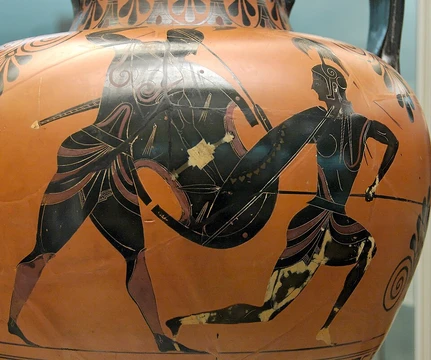
The Minotaur, also known as Asterion or Asterius, is a mythical creature from Greek mythology, typically depicted with the head and tail of a bull and the body of a man, or as described by the Roman poet Ovid, a being 'part man and part bull.' It dwelt at the center of the Labyrinth, an elaborate maze designed by Daedalus and his son Icarus on Crete, and was eventually slain by the Athenian hero Theseus. The Minotaur is significant as a symbol of monstrous hybridity and as a central figure in the myth of Athenian tribute and heroic rescue.
- also_known_as
- Asterion, Asterius
- mythological_origin
- Offspring of Pasiphaë and a bull sent by Poseidon
- dwelling
- Labyrinth at Knossos, Crete
- slain_by
- Theseus
- known_for
- Being a man-eating hybrid; central to the Theseus myth
Lore & Background
The Minotaur was born after King Minos of Crete, having received a snow-white bull from Poseidon as a sign of favor, chose to keep the bull rather than sacrifice it. To punish Minos, Poseidon caused Minos's wife, Pasiphaë, to fall in love with the bull. With the help of the craftsman Daedalus, who fashioned a hollow wooden cow, Pasiphaë mated with the bull and gave birth to Asterius, the Minotaur. As the unnatural offspring of a woman and a beast, the Minotaur had no natural nourishment and devoured humans. Minos, following advice from the oracle at Delphi, had Daedalus construct a gigantic Labyrinth to hold the creature.
Reader's Guide
The Minotaur's significance lies in its role as a central figure in one of the most enduring myths of ancient Greece, embodying themes of hubris, divine punishment, and heroic triumph. The creature's name, meaning 'Bull of Minos,' reflects its connection to the Cretan king and the bull cult. The myth has been interpreted variously: some 19th-century mythologists saw the Minotaur as a personification of the sun or a Minoan adaptation of Phoenician Baal-Moloch, while others, like A. B. Cook, viewed Minos and the Minotaur as different forms of the same sun-god. The Labyrinth itself, though never found, may have been inspired by the complex palace of Knossos. The Minotaur's legacy extends into medieval and modern fantasy, where the notion of a race of minotaurs emerged, though originally it was a unique being. Its depiction in art has varied, from the classical man-bodied, bull-headed form to the medieval and Renaissance reverse configuration of a man's head on a bull's body.
Did You Know?
- The Minotaur was also known as Asterion or Asterius, a name shared with Minos's foster-father.
- The word 'Minotaur' derives from Ancient Greek, combining 'Minos' and 'tauros' (bull), meaning 'Bull of Minos'.
- The notion of multiple minotaurs as a race first appeared in the 7th or 8th century work 'The Cosmography of Aethicus Ister'.
- Some accounts say the Minotaur was slain by Theseus with his sword, a club, or his bare hands.
Common Misconceptions (Editorial)
Some believe the Minotaur was the offspring of King Minos, but the facts show it was born to Minos's wife, Pasiphaë, after she mated with a bull sent by Poseidon. Another common misconception is that the Minotaur was a purely Greek invention; however, records indicate the idea of multiple minotaurs as a race first appeared in the 7th or 8th century work "The Cosmography of Aethicus Ister." Also, while Theseus is universally credited with slaying the Minotaur, the specific weapon varies across accounts — some say he used a sword, others a club, or even his bare hands.
Why It Matters (Editorial)
The Minotaur endures as a powerful symbol of the monstrous and the unnatural, challenging our understanding of boundaries between human and beast. Its story — from its unnatural birth in a wooden cow to its death in a maze — continues to resonate as a cautionary tale about hubris, divine punishment, and the heroism required to confront what society hides away.
Spotted an error? Know more?
This is a living reference — every entry is fact-audited, and reader corrections feed straight into our audit queue. Suggest an edit · See this site's audit record