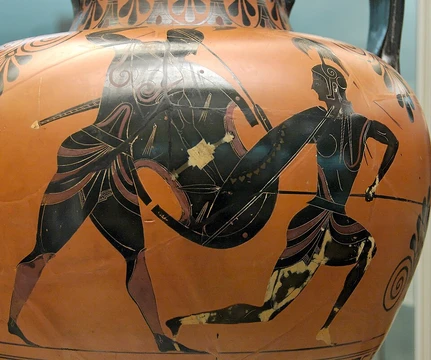
The Titans
Pre-Olympian deities overthrown in the Titanomachy.

In Greek mythology, the Titans were the deities who preceded the Olympians. According to Hesiod's Theogony, they were the twelve children of the primordial deities Uranus (Sky) and Gaia (Earth): six male Titans (Oceanus, Coeus, Crius, Hyperion, Iapetus, and Cronus) and six female Titanesses (Theia, Rhea, Themis, Mnemosyne, Phoebe, and Tethys). They represent a pre-Olympian order and were overthrown as part of the Greek succession myth, culminating in a ten-year war called the Titanomachy, after which the vanquished Titans were banished to Tartarus.
- Origin
- Children of Uranus and Gaia
- Number
- Twelve (six male, six female)
- Known For
- Preceding the Olympians as ruling deities
- Key Event
- Overthrown in the Titanomachy
- Aftermath
- Imprisoned in Tartarus
Lore & Background
The Titans were the former gods, the generation before the Olympians. According to Hesiod, Cronus, the youngest Titan, castrated his father Uranus with a sickle made of adamant, enabling the Titans to be born and Cronus to assume supreme command. Cronus then married his sister Rhea, who bore the first generation of Olympians: Zeus, Hera, Poseidon, Demeter, Hades, and Hestia. Certain other children of Titans, such as Prometheus, Atlas, Helios, and Leto, are sometimes also called Titans.
Reader's Guide
The Titans are significant as the foundational generation of Greek gods, providing a backstory for the Olympian pantheon. Their mythology, borrowed from the Near East, explains how the Olympians came to power. Hesiod's twelve Titans—six male and six female—served genealogical functions, with many existing primarily to parent more important figures. The Titanomachy, a ten-year war, ended with Zeus and the Olympians overthrowing Cronus and the Titans, who were then imprisoned in Tartarus. Some Titans, like Oceanus and Helios, were allowed to remain free. The Titans were considered 'former gods' and were associated with the underworld, invoked as chthonic spirits. Their role in Greek cult was minimal, but they remain central to the succession myth that shaped Greek cosmology.
Did You Know?
- According to Hesiod, the twelve Titans were the children of Uranus and Gaia.
- The Titanomachy was a ten-year war between the Titans and the Olympians.
- Some Titans, such as Oceanus and Helios, were allowed to remain free after the war.
- Plato's Timaeus includes a genealogy where Oceanus and Tethys are parents of Cronus and Rhea.
Common Misconceptions (Editorial)
- Some believe all Titans were monstrous or evil, but the facts show they were the original ruling deities, a generational predecessor to the Olympians, not inherently villainous. - It’s sometimes thought all Titans were imprisoned after the Titanomachy, but the facts note that some, such as Oceanus and Helios, were allowed to remain free.
Why It Matters (Editorial)
The Titans endure because their story is foundational to how the ancient Greeks understood cosmic order, power, and succession — a cycle of overthrow that echoes in countless later myths and narratives. Their struggle against the Olympians reflects timeless questions about authority, rebellion, and the price of victory, keeping them relevant as symbols of a bygone age that shaped the gods we know today.
Spotted an error? Know more?
This is a living reference — every entry is fact-audited, and reader corrections feed straight into our audit queue. Suggest an edit · See this site's audit record