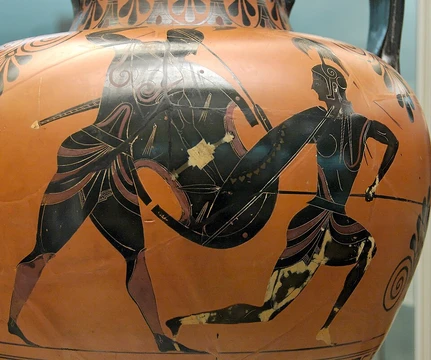
The Trojan War
Legendary Greek war against Troy, central to Homeric epics.

The Trojan War was a legendary conflict in Greek mythology, traditionally dated to the thirteenth or early twelfth century BC. It was waged by the Achaeans (Greeks) against the city of Troy after Paris of Troy took Helen from her husband Menelaus, king of Sparta. The war is one of the most important events in Greek mythology, narrated through many works of Greek literature, most notably Homer's Iliad and Odyssey.
- field
- Greek mythology, legendary warfare
- known_for
- Central conflict in Homer's Iliad and Odyssey; subject of the Epic Cycle
- location
- Troy (near the Dardanelles, modern Hisarlık, Turkey)
Lore & Background
The war arose from a sequence of events beginning with a quarrel among the goddesses Hera, Athena, and Aphrodite, instigated by Eris. Paris, a Trojan prince, judged Aphrodite the fairest, earning her favor and the love of Helen, wife of Menelaus. Menelaus and his brother Agamemnon led an Achaean expedition to Troy, besieging the city for ten years. The Iliad covers a short period in the last year of the siege, while the Odyssey recounts Odysseus's journey home after the war. Other parts of the war are described in the Epic Cycle, including the Cypria, Aethiopis, Little Iliad, Iliou Persis, Nostoi, and Telegony, which survive only in fragments.
Reader's Guide
The Trojan War's significance lies in its central role in Greek mythology and its enduring influence on Western literature. The war is narrated in Homer's Iliad and Odyssey, composed between the ninth and sixth centuries BC, and in the Epic Cycle. These works, along with later Greek tragedies by Aeschylus, Sophocles, and Euripides, and Roman poems by Virgil and Ovid, shaped cultural narratives of heroism, fate, and the consequences of war. The historicity of the war remains an open question; many scholars believe there is a historical core, possibly a fusion of Mycenaean Greek sieges. The war's legacy includes its use as a foundational myth for Rome through Aeneas, and its continued reinterpretation in art and literature.
Did You Know?
- The Iliad describes only four days and two nights in the tenth year of the decade-long siege of Troy.
- The ancient Greeks believed Troy was located near the Dardanelles and that the war was a historical event of the twelfth or thirteenth centuries BC.
- By the mid-nineteenth century AD, both the war and the city were widely seen as non-historical until Schliemann's excavations at Hisarlık.
- The Epic Cycle poems, which cover other parts of the war, survive only in fragments, with their content known from a summary in Proclus's Chrestomathy.
Common Misconceptions (Editorial)
1. A common misconception is that the *Iliad* covers the entire Trojan War. In fact, it describes only four days and two nights in the tenth year of the siege. 2. Another misconception is that the war was always considered purely fictional. The ancient Greeks believed Troy was a real place and the war a historical event; it was only by the mid-nineteenth century AD that both were widely seen as non-historical, until Schliemann’s excavations at Hisarlık.
Why It Matters (Editorial)
The Trojan War endures because it is more than a story of combat—it is a foundational myth that explores themes of pride, love, fate, and the cost of glory. By linking the legendary with glimpses of possible history, it continues to challenge our understanding of where myth ends and fact begins, ensuring its place in both literature and archaeology.
Spotted an error? Know more?
This is a living reference — every entry is fact-audited, and reader corrections feed straight into our audit queue. Suggest an edit · See this site's audit record